
The problem with tracking safety-critical gear
A chain hoist lifts thousands of kilograms of lighting, sound, and staging above a live crowd. There are hundreds of them in a busy rigging operation, each with a service history, a load rating, and a certification date that must not lapse. Where each unit is, which project it's on, and whether it's cleared for use is not paperwork — it's a safety obligation.
The turn: the tool that started the operation became its ceiling
Stage Design ran this on a no-code app that got the operation off spreadsheets, but hit a wall as it grew: it couldn't scale to the full fleet, struggled with real multi-user field use, and — critically for crews working in venues and loading docks — it needed a live connection to do anything. The app that had gotten the operation organized was now the thing holding it back.
What we built
A purpose-built mobile system that runs in a field crew's hand. It tracks every chain hoist through its whole lifecycle — in stock, assigned to a project, out for maintenance, certified or overdue — and it keeps working when the signal doesn't.
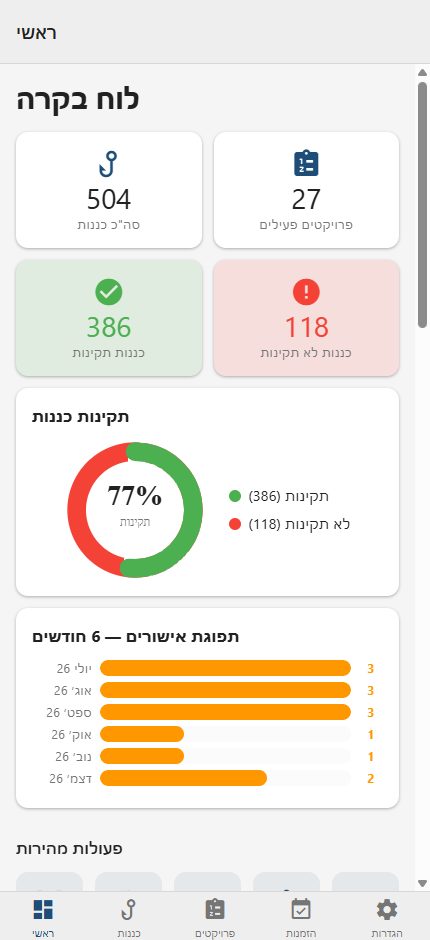
- Offline-first, by design. Crews scan and update gear in venues, warehouses, and loading bays where connectivity is unreliable. The app works fully offline and reconciles when it's back on the network — no lost updates, no "please try again."
- Certification is a first-class citizen. Every hoist carries its inspection and load-certification status. Overdue units are visible before they're accidentally sent to a job, turning a safety liability into a routine check.
- Built for many hands. A real multi-user database (PostgreSQL) underneath, so a warehouse manager and three field techs can all be working the fleet at once without stepping on each other.
- Five permission levels. From a tech who scans and reports to a manager who assigns gear across projects — access matches responsibility.
- Ready for RFID. The architecture is designed so tag-based scanning can slot in as its own phase, turning a manual lookup into a tap.
The results: why we left the no-code app behind
| Constraint on the old app | In the native build |
|---|---|
| Scaling to the full fleet | real database, built for hundreds of units |
| Working without signal | fully offline-capable |
| Multi-user field editing | concurrent, role-based |
| Per-seat platform fees | infrastructure you own |
No-code platforms are a superb way to start — they prove the workflow and get a team off spreadsheets fast. But when the tool becomes load-bearing for a safety-critical operation, its ceilings (scale, offline use, licensing) stop being annoyances and start being risks. The native rebuild keeps everything the team already learned to rely on, and removes the ceiling.
What we learned
- Offline isn't a feature, it's the premise. For field crews, "needs a connection" means "doesn't work when I need it." Designing for offline from day one is completely different from bolting it on later.
- Model the safety obligation, not just the object. The valuable data isn't "we own 500 hoists" — it's "which of them are certified, and which are about to lapse." Certification status drives the whole system.
- Scope down to ship. An early version carried a second equipment type; cutting it to focus purely on chain hoists made the build faster and the app clearer. Delete before you add.
- Respect the migration, not just the rewrite. Replacing a working no-code app means honoring the workflows people already depend on — the goal is a smoother version of what they know, not a foreign new tool.
Where this applies
If you manage a fleet of physical assets in the field — especially where safety, certification, or inspection matters — this architecture fits:
- Rigging, staging, and live-event equipment
- Rental houses with gear moving across many jobs
- Construction and industrial equipment with inspection cycles
- Any operation that outgrew a spreadsheet or a no-code app
Your data on infrastructure you own, in an app that works whether or not the venue has WiFi.
Outgrown your spreadsheet or no-code app?
Let's talk about a field system that scales with the operation.
Talk to Us