
The problem every veteran company has
Stage Design Israel is the country's leading stage-construction and live-event infrastructure company. Like every firm that's been around for twenty years, it sits on an archive nobody can search: ~34,000 AutoCAD drawings and ~62,000 photos spread across network drives, organized by folder conventions that changed three times over the years, with filenames like DSC_1526.JPG and B09.dwg.
The institutional memory was real — "we built something like this for that festival in 2011" — but finding the actual file meant asking the one person who remembered, or an hour of folder spelunking. When that person is busy, on vacation, or eventually retires, the archive is effectively write-only.
The turn: every fix on the market cost more than the problem
The standard fixes all had the same two problems: servers and subscriptions. Self-hosted photo tools (we tried) mean Docker stacks that fall over and a machine someone has to babysit. Enterprise search products price per-seat, per-month, forever — and none of them handle Hebrew properly.
What we built instead
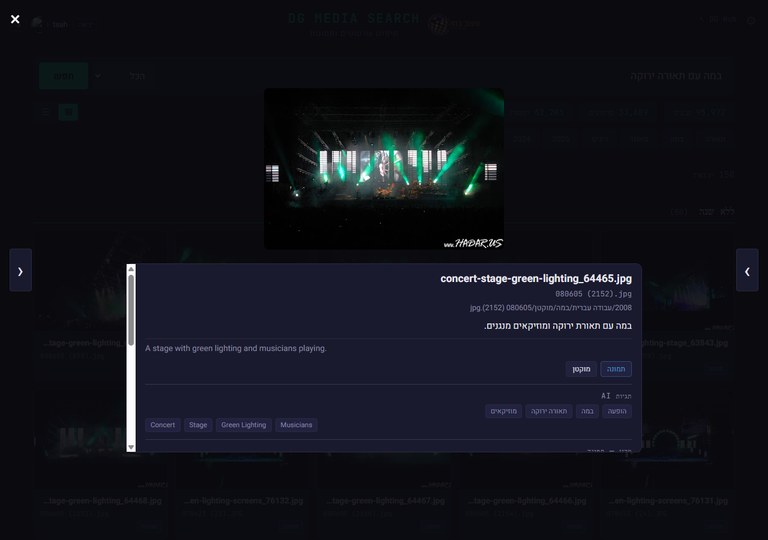
A search box. An office user types, in free-form Hebrew, "במה עם תאורה ירוקה" ("a stage with green lighting") — and gets back the right photos and drawings from all 130,000+ files, ranked by what's actually in them, in under a second.
Behind that search box:
- Every photo and drawing was described by AI, in both Hebrew and English — descriptions, tags, even per-face descriptions (57,000+ faces). Search matches meaning, not just filenames.
- Hebrew is a first-class citizen. The search engine understands Hebrew morphology (a search for אוהלים finds files tagged אוהל), the UI is RTL, and every AI output is bilingual so both Hebrew and English queries work.
- Drawings are visible, not just listed. CAD files get preview thumbnails extracted from the DWG itself — no AutoCAD license needed to browse the archive.
- Duplicates found and flagged across the whole archive — both exact copies and visually-identical shots — using metadata-only hashing that never downloads the file (about 100× faster than the naive approach).
- Sign-in with the company Google account. No new passwords, domain-restricted, sessions renew silently.
The results: the part that sounds impossible is the bill
| Item | Cost |
|---|---|
| Servers | 0 — none exist |
| Software licenses | 0 |
| Hosting | free tiers |
There is no server anywhere in this system. The archive stays where it already lives (Google Drive, synced from the office NAS). A lightweight indexer crawls it; a serverless API and database (Cloudflare Workers + D1 + R2) hold the search index and thumbnails; the UI is a static page. Every component runs comfortably inside free tiers.
The AI work — the part vendors quote five figures for — ran on a small farm of repurposed office PCs coordinated over a private mesh network, cascading across three AI providers' free tiers with automatic failover. The entire backlog, projected at 10–11 weeks, drained in the final stretch at ~2,900 files/day.
What we learned the hard way (why this is a service, not a weekend project)
Honesty section. The polished result above hides months of dead ends that we now know how to skip:
- CAD previews: four extraction approaches failed (two converters topped out at 12% success, two at 0%) before the fifth — reading the thumbnail AutoCAD embeds inside the DWG itself — hit ~95%.
- Free-tier AI is anti-parallel. Our first farm ran 10 machines in sync — they burned the entire daily quota in one hour and sat dead for 23. Three machines with randomized pacing produced 3× more per day than ten. Counter-intuitive, and the single most valuable operational lesson of the project.
- Cheap translation models hallucinate. One translation model turned "נואם" (a speaker) into a person named "Noah." Every AI output now goes through quality gates; when we later found ~14% of early outputs below today's standard, the fix was one database statement — the system re-processed all of them automatically within days, because the whole pipeline is built as a self-healing state machine.
- Hebrew breaks things. Encoding corruption, RTL layout, morphology in search, bilingual consistency — every layer needed Hebrew-aware decisions that generic tools don't make.
Where this applies
If your company has years of accumulated drawings, photos, documents, or scans on a NAS or shared drive — and finding anything depends on someone's memory — this exact architecture rebuilds for you:
- Event production, AV and staging companies
- Scenery, exhibition and set builders
- Architecture and engineering firms
- Manufacturers with decades of CAD history
- Any Hebrew-speaking office where global search tools fall short
Your files stay in your storage. There are no servers to maintain and no per-seat fees. The heavy AI lift is a one-time process at a cost that rounds to zero.
Have an archive nobody can search?
We'll tell you in one call whether this architecture fits your files.
Talk to Us